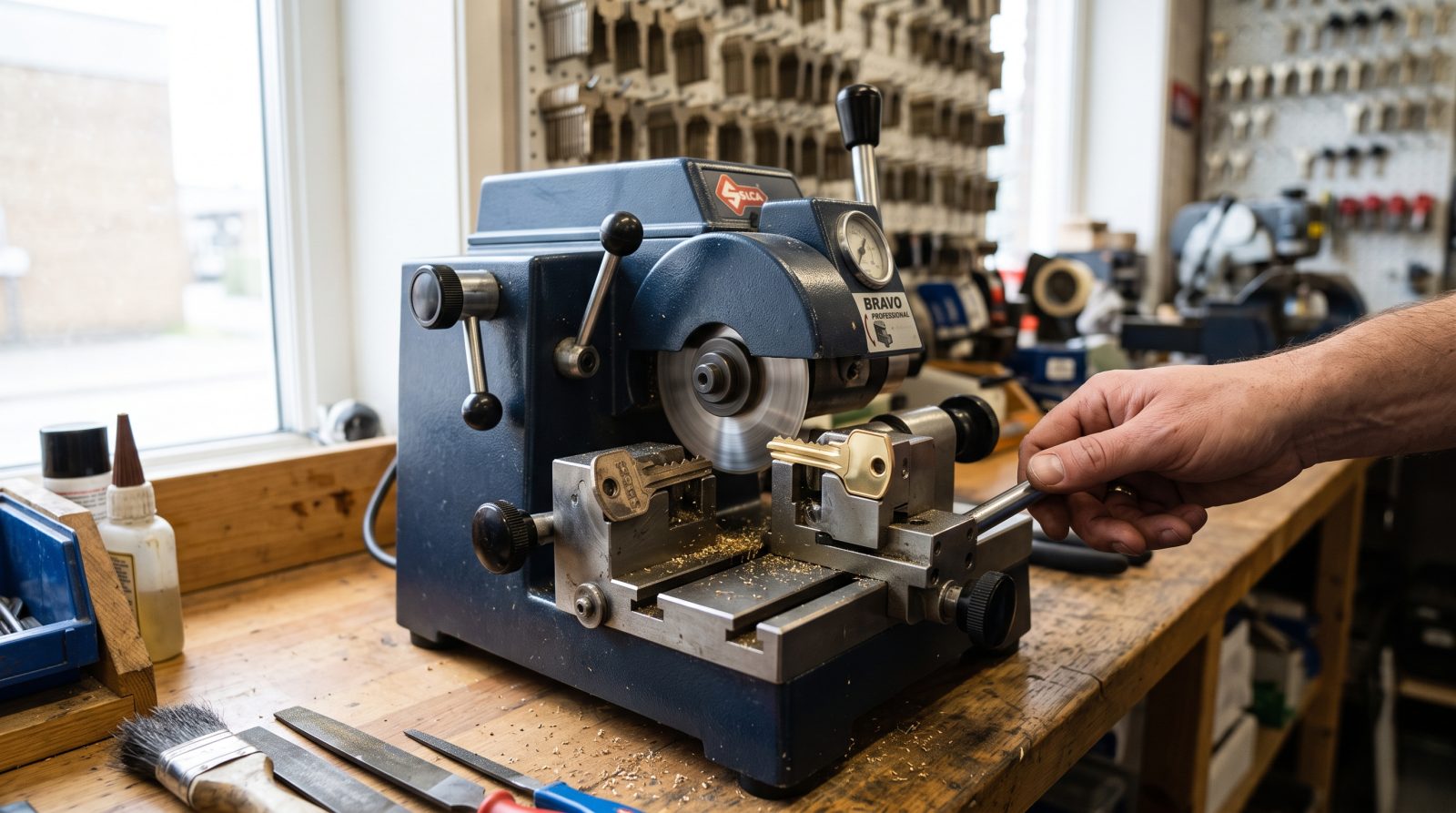
What is key duplication and how does it work?
Key duplication makes a copy of a key you already have. A locksmith reads the original key's blade, including the depth and spacing of its cuts, then selects a matching blank and reproduces that pattern so the copy operates the same lock.
There are two common methods. Mechanical duplication uses a key-cutting machine: the original is clamped next to a blank, a guide traces the original's edge, and a cutting wheel mirrors those cuts onto the blank. Code cutting works from the key's bitting code (the number sequence that describes each cut) and cuts a fresh key to spec without tracing the original, which is useful when a key is worn or you only have the code on file.
After cutting, the copy is usually deburred (rough edges smoothed) and test-fit in the lock or compared against the original. A good copy turns smoothly without forcing. When a duplicate is cut from an already-worn key, small errors can add up, so cutting from a clean original or from code generally produces a more reliable copy.
Which keys can be copied, and which are harder?
Most everyday keys are straightforward to duplicate. The difficulty depends on the key type, whether it carries electronics, and whether the keyway is restricted.
- Standard house and deadbolt keys (edge-cut, Kwikset- or Schlage-style): typically quick to copy onto a common blank.
- Padlock, cabinet, mailbox, and desk keys: usually easy, though some compact or tubular keys need a specific blank.
- Dimple keys and high-security keys: copyable, but often require a specialized blank and machine; some are sold only to registered owners.
- Restricted or patented keyways: deliberately limited; copies generally require proof of authorization and may only be available through the system's dealer or locksmith network.
- "Do Not Duplicate" (DND) keys: this is a policy stamp, not a physical lock; reputable providers ask for authorization before copying these.
- Transponder and remote (fob) car keys: these contain a chip or electronics that must be programmed to the vehicle, so they involve more than cutting a blade.
House keys vs. car keys: what's the difference?
For a basic house key, duplication is mostly a mechanical task: match the blank, cut the pattern, test the fit. That is why simple house-key copies tend to be fast and inexpensive.
Car keys are more involved. Many modern vehicle keys include a transponder chip, and many add a remote (fob) or are a single smart key. Cutting the metal blade is only part of the job; the chip usually has to be programmed so the car's immobilizer recognizes it, and some makes require the vehicle to be present. A laser-cut (sidewinder) car key also needs a different cutting machine than a standard edge-cut key.
Because of this, a 'spare car key' is better described as car key duplication plus programming. If you are copying a car key, expect the locksmith to ask for the year, make, and model, and to confirm whether the key is a basic non-chip key, a transponder key, a remote-head key, or a proximity smart key.
How much does key duplication typically cost?
Prices vary by key type, region, and whether programming is involved, so the figures below are typical industry ranges meant as estimates, not quotes. Your actual price depends on your specific key and situation.
The single biggest cost driver is whether the key is purely mechanical or carries electronics. A plain brass house-key copy sits at the low end; a chipped or smart car key that needs programming sits much higher because of the blank, the equipment, and the programming time.
- Standard house or padlock key copy: roughly $2 to $10 each as a typical range.
- High-security, dimple, or restricted-keyway copy: often $15 to $40 or more depending on the system and authorization required.
- Non-chip ('mechanical') car key copy: commonly $10 to $40 for cutting alone.
- Transponder or remote car key with programming: frequently $80 to $250 or more depending on the vehicle and key type.
- Mobile or after-hours service: may add a service or trip fee on top of the per-key price.
- Always confirm the total before work begins, and treat any number you see online as an estimate rather than a fixed price.
When to copy a key vs. rekey or replace a lock
Duplication is the right move when you trust everyone who would hold a copy and you simply want more working keys, for example a spare for a partner, a hide-a-key for emergencies, or copies for household members.
Duplication is not the right move when you have lost control of who has a key. Making another copy of a key that an ex-tenant, former employee, or unknown party may still hold does nothing to lock them out. In that case rekeying is usually the better option: a locksmith changes the lock's internal pins so all old keys stop working and issues you fresh keys, often without replacing the hardware.
Full lock replacement makes sense when the lock is damaged, worn, outdated, or you want to upgrade to higher-security or smart hardware. A quick rule of thumb: copy a key to add access for people you trust, rekey to revoke access from people you do not, and replace when the lock itself is the problem.
Getting a key copied with Locksmith Near Me
Locksmith Near Me connects people with local locksmith help, including key duplication and copying. Whether you need a single spare or multiple copies for a home, rental, or workplace, the process starts with telling us what kind of key you have.
To help match the right blank and service, have these details ready: the type of key (house, padlock, mailbox, office, or car), how many copies you need, and whether the key is stamped 'Do Not Duplicate' or part of a restricted system. For car keys, also have the vehicle year, make, and model, and note whether the key has a chip or remote.
When you are ready, request a free quote and we will point you to local locksmith help for your key. The fastest way to start is the free-quote or contact action on this page.