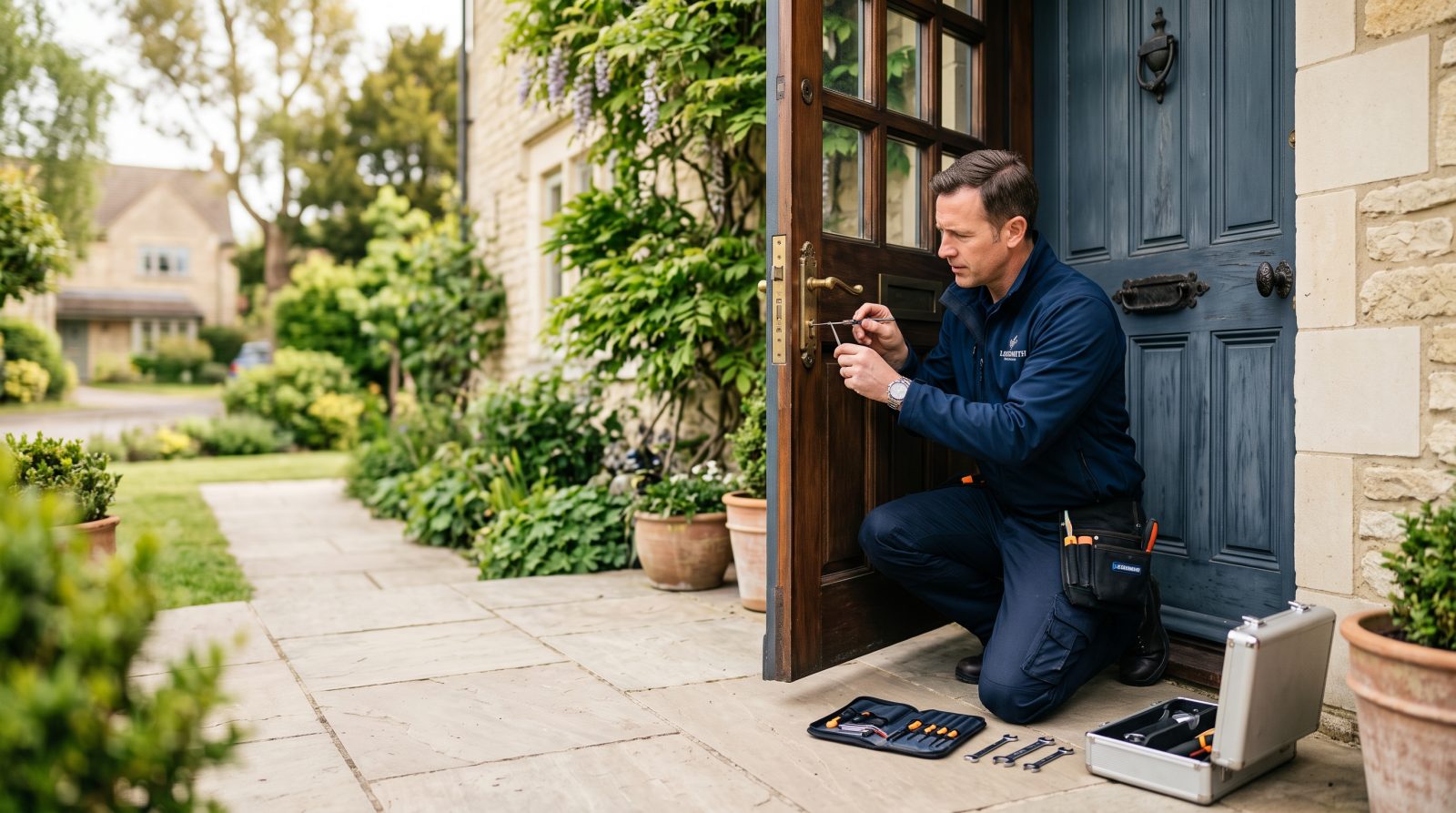
What is a house lockout service?
A house lockout service is residential locksmith help focused on one goal: getting an authorized person back inside their home after they've been locked out. It covers the common situations homeowners and renters run into, including keys locked inside, a lost or broken key, a door that latched behind you, a jammed deadbolt, or a key that snapped off in the cylinder.
The defining feature of professional lockout work is that locksmiths aim for non-destructive entry whenever the lock and door allow it. That means opening the door using locksmith tools and techniques rather than forcing or breaking it. When non-destructive entry isn't possible, or when the existing hardware is already failing, the locksmith will explain the options before doing anything that affects your door or lock.
This is different from a rekey or lock-change visit, which you'd schedule on purpose to change who can open a working lock. A lockout call is reactive: the lock usually works fine, you just don't have a way to operate it at that moment.
- Keys locked inside the house
- Lost, stolen, or broken house key
- Door that self-locked behind you
- Key broken off inside the lock cylinder
- Jammed or seized deadbolt that won't turn
What happens during a home lockout call?
A typical home lockout call follows a predictable sequence, and knowing it ahead of time makes the visit go faster. The first step is almost always verification: a reputable locksmith will ask you to confirm that you're authorized to enter the property before opening any door. This protects you and your neighbors, so expect the question and have something ready.
After verification, the locksmith assesses the door and lock to choose the safest approach. Many standard residential locks can be opened without damage. If the lock is high-security, badly worn, or already broken, the locksmith will walk you through what's realistic, what it involves, and what it may cost before proceeding.
Once you're back inside, the locksmith can address whatever caused the lockout. If a key snapped in the cylinder, they can often extract it. If the lock itself is failing, they can repair or replace it. If you've lost your only key, this is a natural moment to talk about rekeying or cutting a spare so it doesn't happen again.
- Confirm you're authorized to enter the home
- Inspect the door, lock type, and condition
- Choose non-destructive entry when the hardware allows
- Open the door and get you inside
- Repair, replace, or rekey hardware if needed or requested
How do locksmiths confirm you live there?
Because a lockout service is, by definition, opening a locked door, authorization is the part that protects everyone. A trustworthy locksmith will not open a home for someone who can't show a reasonable connection to the address. This is a feature, not a hassle, and it's worth preparing for so the visit isn't held up.
Common ways people confirm they belong at the property include a photo ID showing the address, mail addressed to them at that home, a lease or mortgage document, or another resident or property manager who can vouch for them. If your ID doesn't match the address yet (for example, you just moved in), be ready to explain and offer whatever documentation you do have.
If you're a tenant, your landlord or property manager may need to authorize entry, and some property managers prefer to arrange the service directly. When in doubt, a quick call to whoever manages the property before the locksmith arrives can save time.
- Photo ID listing the property address
- Mail, a bill, or a delivery addressed to you there
- A lease, rental agreement, or mortgage statement
- A landlord, property manager, or co-resident to confirm
What does a house lockout typically cost?
Pricing for a house lockout varies by your location, the time of day, the type of lock, and how the door has to be opened. The figures below are typical industry ranges meant to help you budget. They are estimates, not quotes, and the only accurate number is the one a locksmith gives you for your specific door after seeing it.
Several factors push a lockout toward the higher or lower end of these ranges. A standard knob or basic deadbolt opened without damage tends toward the lower end. High-security or smart locks, after-hours or holiday visits, broken-key extraction, and any door that ends up needing repair or new hardware all add to the total.
To avoid surprises, ask for the price before work begins, confirm whether there's a service or trip charge, and get any quote that depends on what's found (like a damaged lock) stated as a clear 'if needed' add-on. Request a free quote and we'll connect you with a local locksmith who can give you a real number for your situation.
- Standard residential lockout: roughly $75-$180 (typical range, estimate only)
- After-hours, weekend, or holiday visit: often higher than the standard range
- Broken-key extraction: added cost on top of the lockout, varies by lock
- Lock repair or replacement if hardware is damaged: priced separately
- Always confirm any trip or service charge before work starts
What to do while you wait to get back in
If you're locked out, a few calm steps make the situation safer and the eventual fix faster. First, check the obvious before assuming the worst: try every door, and see whether a partner, housemate, or family member has a key or is on the way. Don't attempt to force a window or door yourself; injuries and broken glass are far more expensive than a lockout, and a damaged frame can make the locksmith's job harder.
While you wait, gather what you'll need to confirm you live there so the locksmith can verify you quickly. If it's cold, dark, or you feel unsafe, wait somewhere secure such as a car, a neighbor's home, or a nearby public place, and keep your phone charged.
If anyone is trapped inside who is at immediate risk, or if there's a medical emergency, a fire, or a child or pet in danger, call 911 first. A locksmith handles lockouts; emergency services handle emergencies, and getting the right help first is always the priority.
- Try all doors and check if someone nearby has a key
- Don't force windows or doors yourself
- Get your ID and proof of address ready
- Wait somewhere safe and keep your phone charged
- Call 911 first if anyone inside is in danger
Preventing the next house lockout
Most lockouts are repeatable situations, so a little planning pays off. After a locksmith gets you back in, it's a good time to set up a backup so the next slammed door is a minor inconvenience instead of a service call. Spare keys are the simplest fix: have one or two cut and leave them with someone you trust rather than hidden outside, where they can undermine your security.
If you've lost your only key, ask the locksmith about rekeying. Rekeying changes the lock's internal pins so old keys no longer work and a new key does, which secures the home without replacing the whole lock; it's often faster and less expensive than full replacement. If a lock is worn out or you want different features, replacing the hardware may make more sense.
Smart locks and keypad or keyless deadbolts are another way to reduce lockouts, since you can enter with a code, a phone, or a backup method instead of a physical key. Many use rechargeable or replaceable batteries with a low-battery warning, and many quality models still include a traditional key override. Whatever route you choose, the goal is the same: a reliable, secure way to get in that doesn't depend on a single key in your pocket.
- Keep one or two spare keys with people you trust
- Rekey rather than replace when the lock still works
- Consider a keypad or smart deadbolt with a backup method
- Test smart-lock batteries and keep a key override available