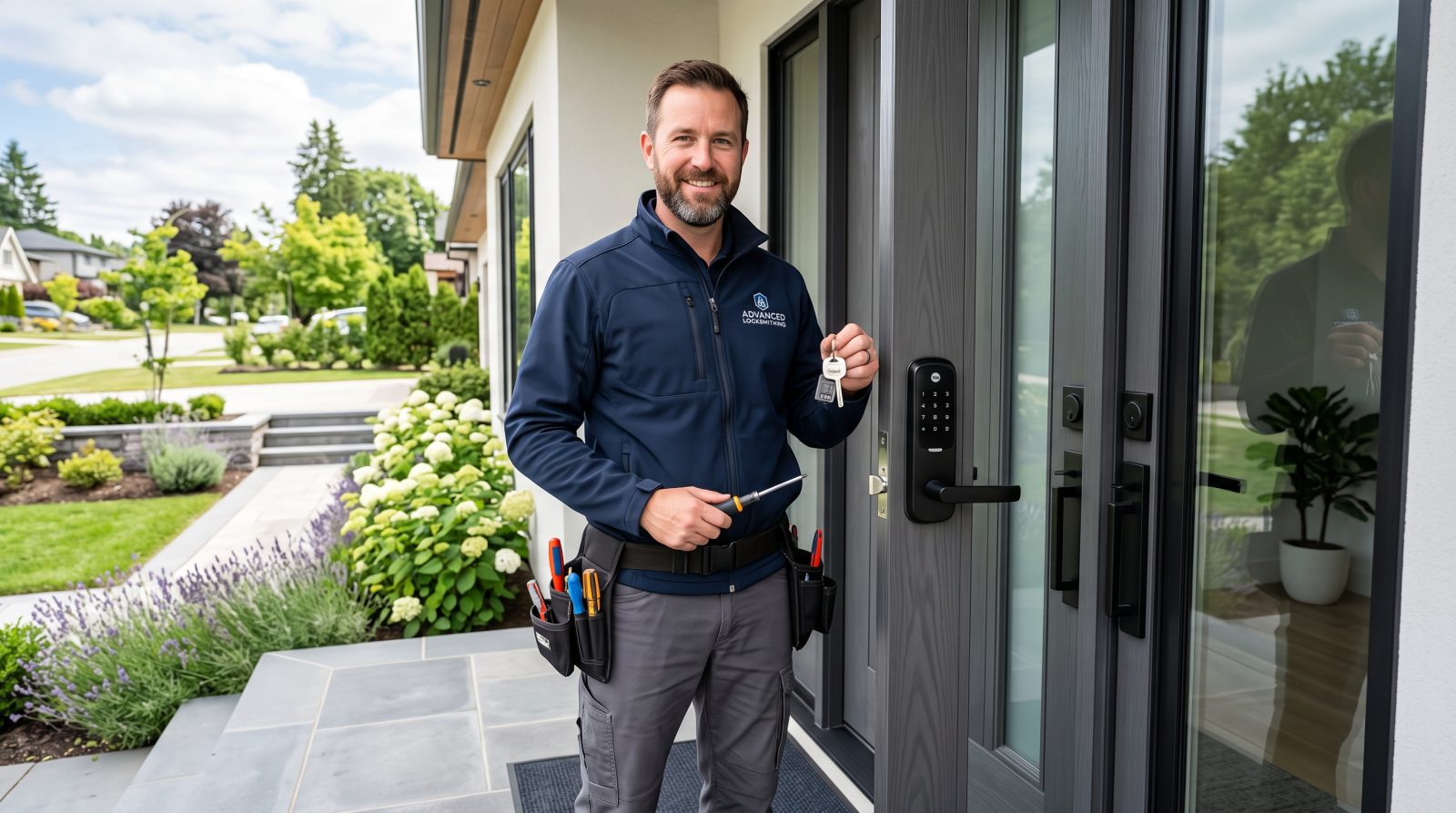
Where do most break-ins actually happen?
Most residential intrusions come through a door or a low, accessible window rather than dramatic forced entry. A surprising share of break-ins involve an unlocked door or window, or a door that's locked but mounted in a weak frame that gives way under a single hard kick. That's good news, because it means the highest-impact fixes are also some of the cheapest.
When a locksmith assesses a home, the first question isn't 'how good is the lock?' It's 'how good is everything around the lock?' A high-quality deadbolt is only as strong as the door it's in, the frame it latches into, and the screws holding the strike plate. A weak link anywhere in that chain undermines the whole entry point.
Think of your home in layers: the perimeter (lighting, sightlines, fencing), the entry points (doors, windows, garage), and the locks themselves. A determined intruder is looking for the path of least resistance. The goal of home security isn't to make your home impenetrable, it's to make it enough of a hassle that someone moves on to an easier target.
How to secure your exterior doors
Your front, back, and side doors are the most common entry points, so they deserve the most attention. A solid-core or metal exterior door resists kicks far better than a hollow-core interior-style door that some homes use by mistake. If you can knock on your door and hear a hollow echo, that's worth addressing.
The single most overlooked upgrade is the strike plate. Many strike plates are held in with short 1/2-inch or 3/4-inch screws that only grip the thin door jamb. Swapping those for 3-inch screws that reach into the wall stud behind the frame dramatically increases how much force the door can take before the frame splits. It's an inexpensive change with an outsized effect.
Beyond the deadbolt and strike plate, consider a reinforced strike plate or a door-frame reinforcement kit, especially on out-of-sight doors like a back or garage-entry door. Sliding patio doors are a known weak point: add a bar or rod in the track to prevent the door from being lifted off or slid open, and check whether the latch can be jiggled loose.
- Use solid-core or metal exterior doors, not hollow-core
- Install a deadbolt with at least a 1-inch (one-inch) throw
- Replace strike-plate screws with 3-inch screws that reach the framing
- Reinforce the jamb on back and side doors, which are often hidden from the street
- Secure sliding doors with a track bar and an anti-lift measure
Which locks should you choose, and what does the grading mean?
Door locks sold in the U.S. are commonly graded by ANSI/BHMA into Grade 1, Grade 2, and Grade 3, based on standardized tests for durability and resistance to force. Grade 1 is the highest residential-and-commercial tier, Grade 2 is a solid mid-range residential choice, and Grade 3 meets minimum residential standards. For exterior doors, many locksmiths suggest a Grade 1 or Grade 2 deadbolt as a reasonable balance of strength and cost.
A deadbolt and the doorknob lock do different jobs. The spring latch in a knob or lever is for convenience and can often be defeated quickly, while a deadbolt has a solid bolt that resists prying and forcing. The deadbolt is the lock doing the real security work, so it's the one worth investing in. Avoid relying on the knob lock alone on any exterior door.
Look for features like an anti-drill plate, a hardened steel bolt, and an anti-pick or anti-bump cylinder if those concerns apply to you. Smart locks can be convenient and add features like keypad entry and access logs, but they don't replace solid mechanical strength, treat the electronics as an add-on to a good deadbolt and door, not a substitute. If you're unsure what fits your doors, a locksmith can recommend hardware suited to your specific setup.
Rekey vs. replace: when to change your locks
Rekeying changes the internal pins of an existing lock so old keys no longer work and a new key takes over, all without replacing the hardware. Replacing swaps out the entire lock for a new unit. Rekeying is typically faster and less expensive because it reuses your existing, working hardware; replacing makes sense when the lock is worn, damaged, low-grade, or when you want a different style or feature set.
There are clear moments when changing your keys is worth it: when you move into a new-to-you home (you have no idea how many copies exist), after a roommate or tenant moves out, when a key goes missing, or after a contractor or service had temporary access. In any of these cases, rekeying restores control over exactly who can open your doors.
A practical bonus of rekeying is that multiple locks can often be keyed alike, so a single key opens your front, back, and side doors. That's convenient and reduces the temptation to leave a door unlocked. A locksmith can rekey on-site and tell you whether rekeying or full replacement is the better value for your specific locks.
- Rekey when you move in, lose a key, or someone with access leaves
- Replace when the lock is damaged, worn, low-grade, or you want new features
- Ask about keying multiple doors alike for a single, convenient key
- Both can usually be done on-site by a locksmith
Don't forget windows, the garage, and spare keys
Ground-floor and basement windows are a common secondary entry point, especially ones hidden behind landscaping. Make sure window latches actually engage, and add secondary security like window locks, pins, or sash stops that limit how far a window opens. For double-hung windows, a simple pin through the frame can stop a window from being slid up from outside.
The garage is an entry point people routinely underestimate. The interior door from the garage into the house should be a proper exterior-grade door with a deadbolt, because once someone is inside the garage they're out of sight. Keep the garage-door opener out of an unlocked vehicle, and if your overhead door has an emergency release that can be tripped from outside, ask about shielding it.
Finally, reconsider the hide-a-key under the mat or in a fake rock, these are the first places anyone looks. If you need a backup plan, a keypad lock, a key kept with a trusted neighbor, or a proper lockbox is far safer. And if you do get locked out, calling a locksmith is the safe route; never try to force a door or window, which can cause damage and injury.
Low-cost habits and the layered approach that ties it together
Hardware matters, but habits and environment do a lot of quiet work. Good exterior lighting near doors and dark corners removes the cover an intruder wants. Motion-activated lights are inexpensive and draw attention to movement. Trimming shrubs away from windows and entry points eliminates hiding spots and improves sightlines from the street and from neighbors.
The cheapest security measure is also the most effective: lock up every time, even for quick errands, and even doors you assume nobody uses. Build a simple routine of checking doors and ground-floor windows before bed and before leaving. When you're away, the goal is to make the home look lived-in, varied lighting and not signaling an empty house go a long way.
No single product makes a home secure. Layering is what works: a strong door and frame, a quality deadbolt, secured windows, a hardened garage entry, smart lighting, clear sightlines, and consistent habits. Each layer adds friction, and friction is what sends an opportunist looking elsewhere. If you'd like help prioritizing upgrades for your home, a locksmith can walk your entry points with you and quote the hardware that fits.
- Add motion-activated lighting at doors and dark corners
- Trim landscaping that hides windows and entry points
- Lock every door and ground-floor window, every time
- Make an empty home look lived-in when you're away
- Layer multiple measures rather than relying on one product